
Afar Region, Ethiopia —(Map)
Hayli Gubbi, a volcano in northern Ethiopia, erupted on Sunday, sending a huge cloud of smoke and ash into the air. The volcano had not erupted in recent history, and the ash cloud has spread into nearby countries, causing some flight delays.
The volcano erupted on Sunday morning, sending a huge cloud of ash and smoke 6 to 9 miles (10 to 15 kilometers) into the air. The eruption was so big that the ash cloud could easily be seen in pictures taken from space.
The eruption did not cause any injuries, but it did cover the nearby village of Afdera with ash.

(Source: ESDIS [Public Domain], NASA Worldview.)
Mohammed Seid, who works for the government in Afdera, told the Associated Press, “It felt like a sudden bomb had been thrown with smoke and ash.”
The ash is making life difficult for the people who live there. Many people in Afdera raise animals, and now the ash is making it hard for the animals to find food.
The huge cloud of ash blew out across the Red Sea. It crossed Yemen and Oman. By Monday, ash was falling on areas of Pakistan and northern India.
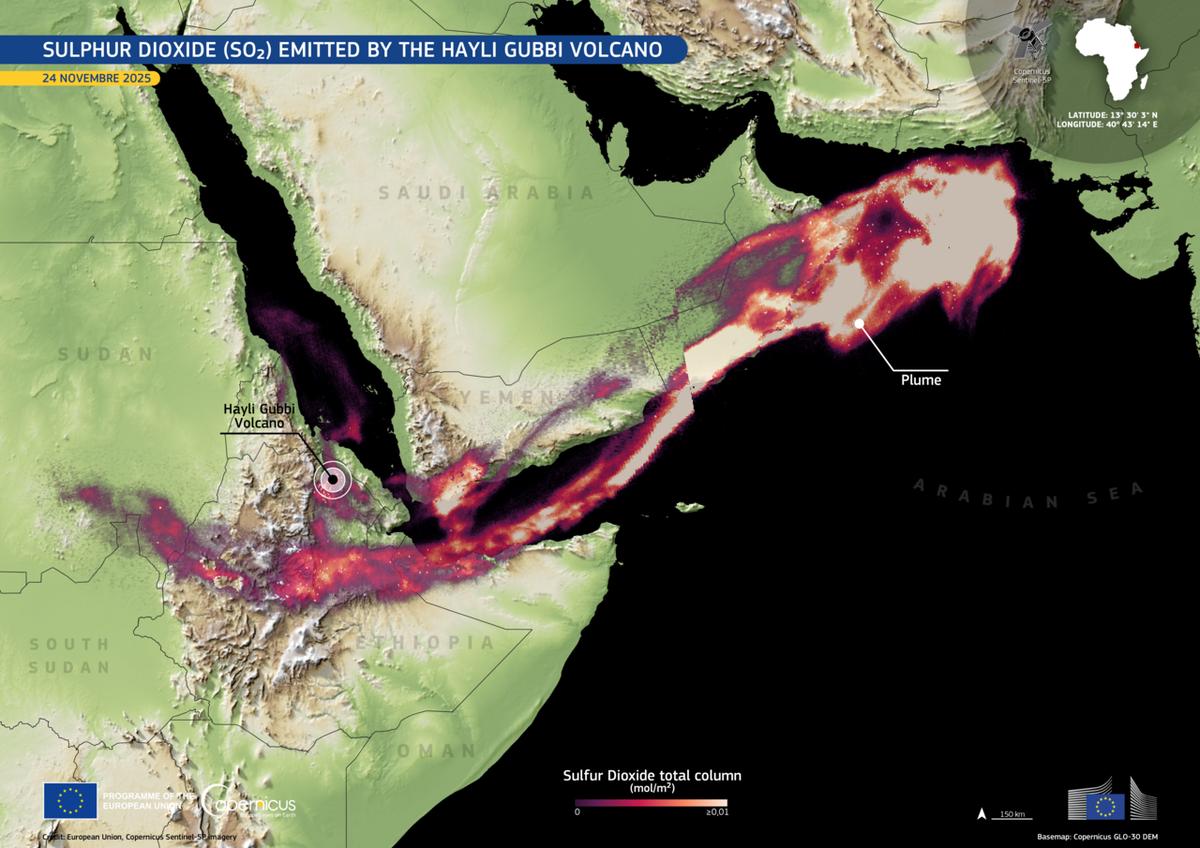
(Source: EU [Contains modified Copernicus Sentinel data 2025], via Wikimedia Commons.)
The ash cloud also caused problems for airlines. Two of India’s airlines, Air India and Akasa, canceled several flights over the last two days. Air India says it is checking its planes that flew near the ash cloud, since the ash can damage engines. By Wednesday, the ash cloud is expected to be moving toward China.
The eruption of the volcano surprised many people. Before Sunday, there were no records of the Hayli Gubbi volcano ever erupting. Some people believe that the volcano had been “dormant” for 10,000 years or longer.
But because Hayli Gubbi is in a very remote area, it’s also possible that earlier eruptions simply weren’t reported. Even now, the Afar region is so remote that scientists are forced to study the volcano through satellite images.
😕
This image has not been loaded because of your cookie choices. To view the content, you can accept 'Non-necessary' cookies.
Some people believe that the volcano had been “dormant” for 10,000 years or longer. But it’s possible that earlier eruptions weren’t reported. One volcano expert says recent satellite images of Hayli Gubbi show “lava flows that are probably less than a few hundred years old.”
One volcano expert told the New York Times that recent satellite images of Hayli Gubbi show “lava flows that are probably less than a few hundred years old.”
The Afar region is known for its volcanoes and earthquakes. The area is part of the Afar Rift, which is a place where the land is slowly pulling apart. This causes cracks in the Earth’s crust, which can lead to volcanoes and earthquakes.
Since the Afar region is an active area for volcanoes, scientists did have some clues that an eruption was possible. Several other volcanoes in the Afar Rift have erupted recently. And in July, a nearby volcano called Erta Ale erupted. It’s only about 7 miles (11 kilometers) away from Hayli Gubbi.
😕
This map has not been loaded because of your cookie choices. To view the content, you can accept 'Non-necessary' cookies.