
Scientists at MIT (Massachusetts Institute of Technology) have created a flying robot that can also dive underwater. The robot is inspired by birds like puffins, which can fly through the air and also dive into the sea. The new robot could help scientists study underwater areas that are hard to reach.
Puffins
Birds like puffins use their wings to fly in the air. But they’re also extremely comfortable underwater, where they use their legs to push, and their wings to steer. When it’s time to fly again, they flap their wings, and use their legs to rapidly paddle across the water’s surface to take off.
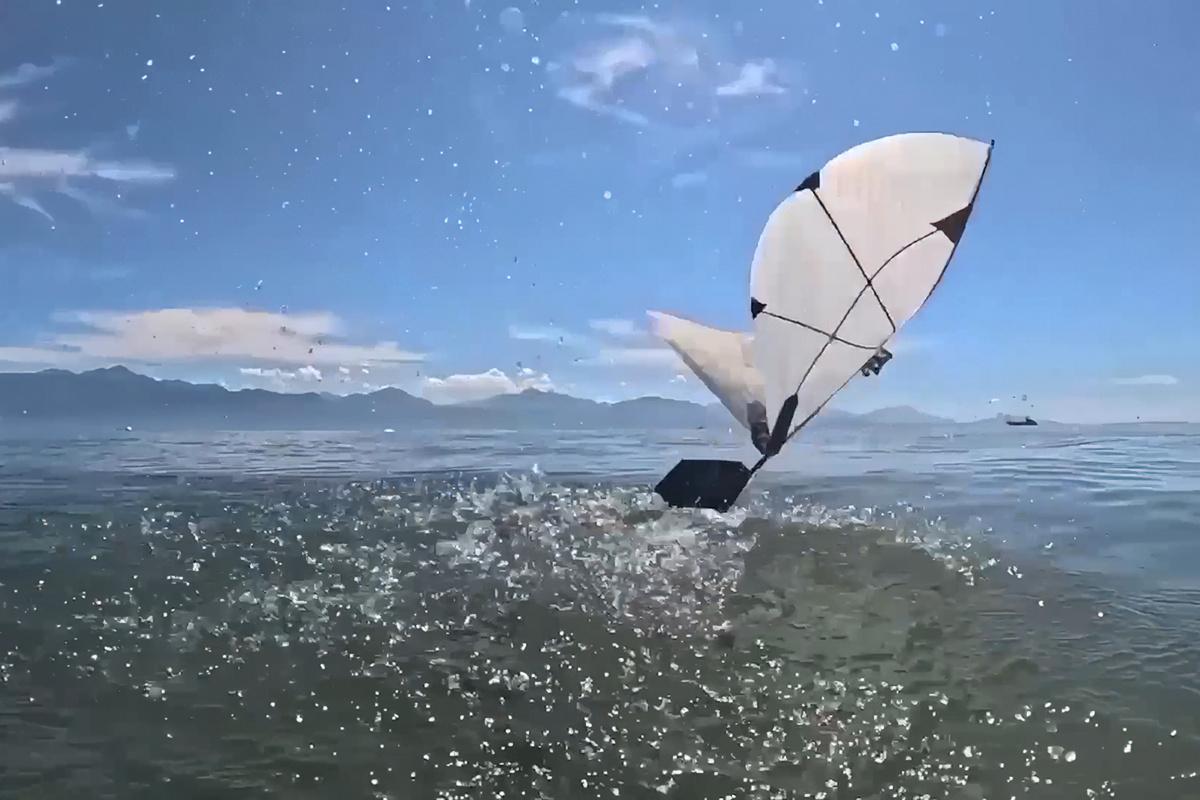
(Source: MIT.)
The idea of making a robot that could do something similar to a diving bird was a challenge that took two years to solve.
Raphael Zufferey, who led the project at MIT, says he thought the problem seemed impossible at first. But he and his team worked patiently. First they studied lots of different birds that can swim and fly. Then, slowly, with a lot of different small experiments along the way, they began to develop their own swimming-flying robot.

(Source: MIT.)
One of the biggest challenges was dealing with how thick and heavy water is compared to air. Many birds just tuck their wings away when they’re underwater. But the scientists wanted their wings to work in both air and water.
They experimented with different wing sizes, and found that a width of about 34.5 inches (88 centimeters) from tip to tip worked the best. The robot’s wings are made from a strong, lightweight fabric stretched across very strong, flexible supports.
In the air, the wings flap five or six times a second, allowing the robot to fly. Underwater, the robot’s wings help it swim. The robot has a motorized tail that can help adjust its position.
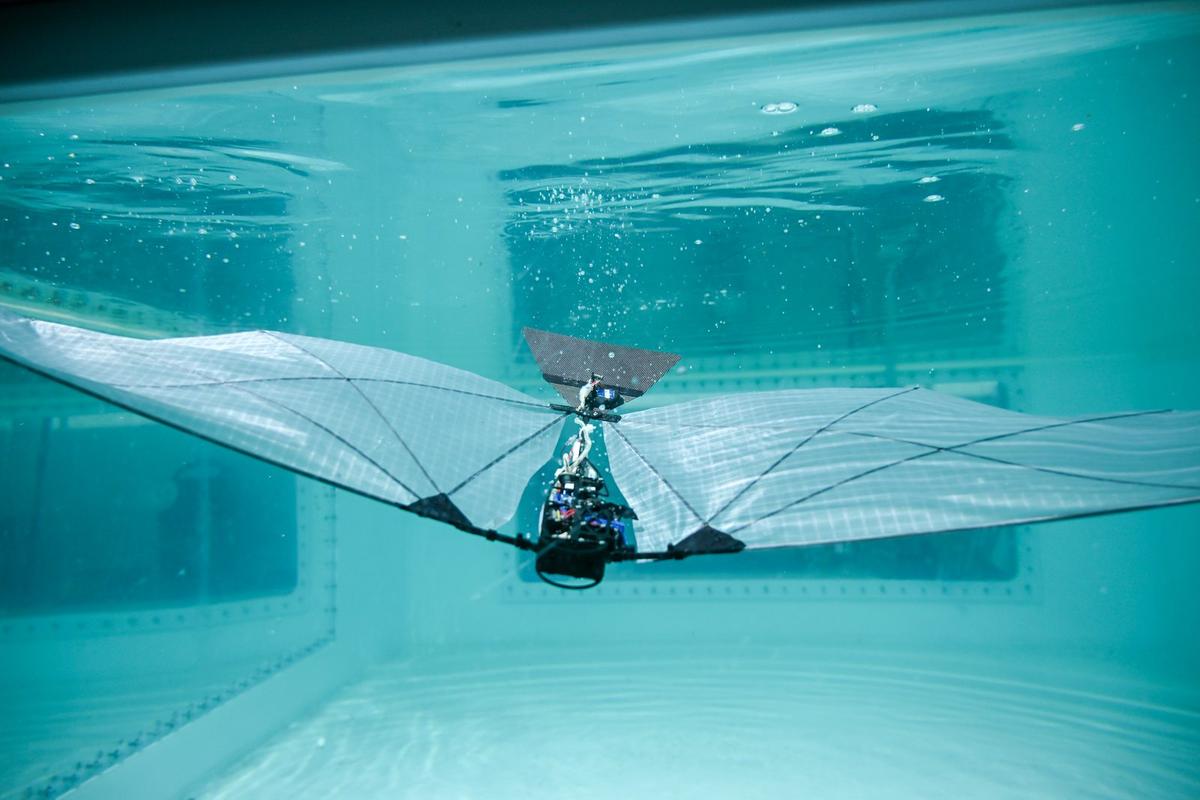
(Source: Raphael Zufferey .)
The robot weighs a little over a half a pound (250 grams). But when it’s in the water, it’s designed to stay level, and not sink or float. To keep the robot light, the researchers chose not to cover its body. Instead, they waterproofed each piece that was inside it.
Though the researchers studied real birds, they didn’t copy everything. For example, their robot doesn’t have legs. Legs were just too complicated to include. So instead, the robot uses its wings to push off from the water and take to the air.
That may sound easy, but it took the team a long time to figure out how to adjust the angle of the robot and its tail to allow it to spring out of the water. When it leaves the water, the robot’s wings have to beat even faster – about 10 times each second.

(Source: Raphael Zufferey .)
The researchers tested the robot in a large tank of water at MIT. They also tested it in Lake Geneva in Switzerland. In a video of the tests, the robot can be seen breaking free of the water and taking flight in under a second.
The scientists are excited about the possibilities of using the robot to study underwater environments. They say the robot could be used to keep an eye on coral reefs, track fish, or study harmful algae growths.
Mr. Zufferey imagines a future where a scientist can carry the robot in a backpack, fly it out to a remote area, and then send it underwater to collect samples or measurements. “If that happens,” he says, “I’m happy.”
Did You Know…?
Currently, the robot can fly about 3.75 miles (6 kilometers) on a full charge, or swim roughly 1.25 miles (2 kilometers) underwater. This is one area the researchers hope to improve, so that the robot will be able to travel much longer distances.