
McDonough, Georgia —(Map)
When a fireball fell through the sky in the southeastern United States on June 26, it caught the attention of people across seven states. It was a meteor breaking up as it fell through the Earth’s atmosphere. A small part of the space rock tore through a house in Georgia. Scientists now say the meteorite is older than the Earth.
Millions of meteors hit Earth’s atmosphere every day, but most are quite tiny – about the size of a grain of sand. These burn into dust. But some parts of larger meteors may actually hit the ground without burning up. These pieces are called meteorites.
A meteor is a chunk of ancient rock from outer space that falls to Earth. As the rock whizzes through the Earth’s atmosphere, it heats up, and so does the atmosphere around it, giving off a glow. A fireball is an especially bright meteor.

(Source: Screenshot, ©Brannon H., via amsmeteors.org.)
Fireballs are more often spotted at night. But the meteor in June was bright enough to be seen in daylight. It also created a boom so loud that people thought there had been an earthquake. When an object goes faster than the speed of sound (around 767 mph/1,235 kph), it creates a loud “sonic boom”. And that’s what people heard that day.
But one house in McDonough, Georgia had a much closer encounter. Several small bits of the meteorite shot through the roof of the house. One piece, roughly the size of a cherry tomato, carried on through both sides of a metal tube, through insulation, and the ceiling before it hit the floor. The meteorite landed just 14 feet (4.25 meters) away from the owner of the house, leaving a dent in the floor larger than a US quarter dollar coin.
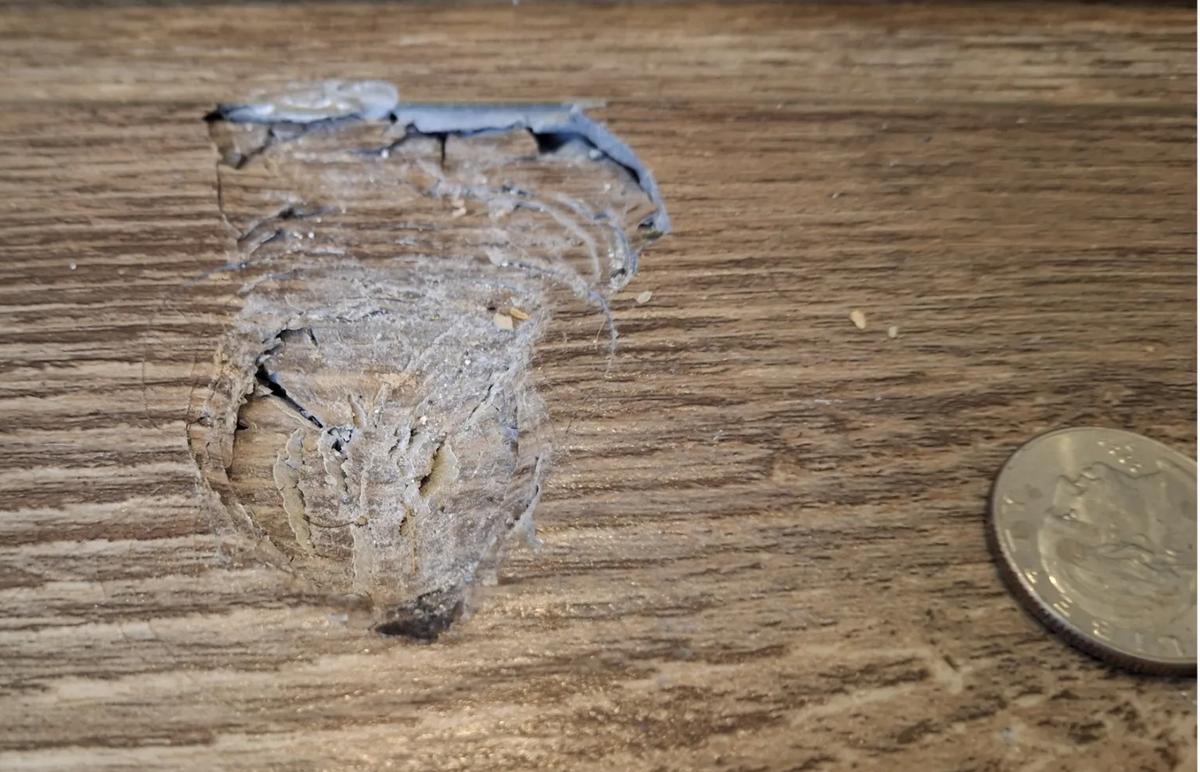
(Source: University of Georgia.)
Scientists at the University of Georgia (UGA) got in touch with the owner of the house to learn more about the impact, and about the meteorite itself. Scott Harris, a geologist at UGA, says the meteorite may have been traveling as fast as 2,237 mph (3,600 kph) when it hit the house.
About 50 grams (1.76 ounces) of meteorite was recovered, and Mr. Harris was allowed to study about half of that material. Using powerful microscopes, he determined that the meteorite was a Chondrite – a kind of stony meteorite made of material created around the time our Solar System was first being formed.
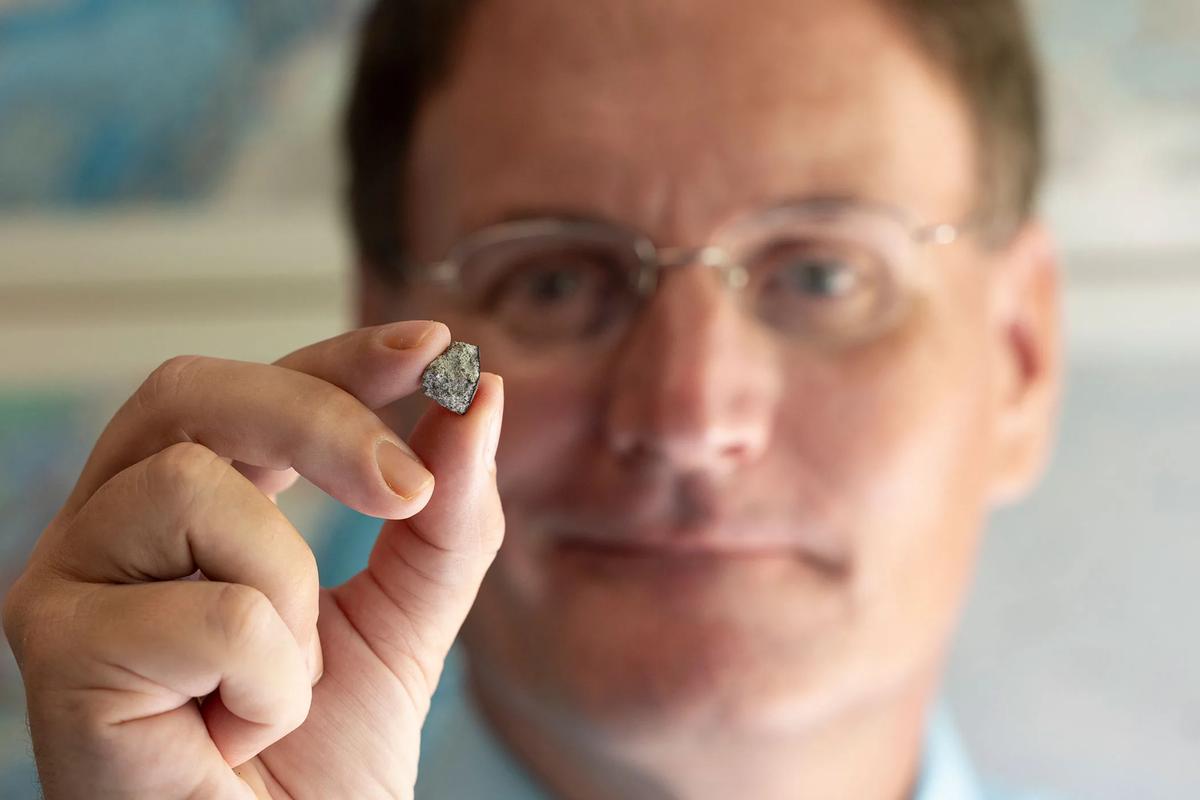
(Source: Andrew Davis Tucker, University of Georgia.)
Mr. Harris says his tests show that the meteorite is about 4.56 billion years old. That would make the meteorite about 20 million years older than the Earth. (Scientists say the Earth is about 4.54 billion years old.)
Mr. Harris says the rock likely came from a much larger asteroid that was once part of the asteroid belt between Mars and Jupiter. He says the large asteroid probably broke up around 470 million years ago.

(Source: Cade Massey, University of Georgia.)
Scientists at UGA and Arizona State University are continuing to study the meteorite. Mr. Harris expects the space rock to be officially called the McDonough Meteorite, since meteorites are usually named after the place where they land.
Did You Know…?
NASA says that as it fell through Earth’s atmosphere, the meteor was probably about 40 inches (1 meter) across, and was traveling at about 29,000 mph (46,670 kph).
😕
This map has not been loaded because of your cookie choices. To view the content, you can accept 'Non-necessary' cookies.