
Beijing, China —(Map)
On April 19, about 12,000 runners took part in a half marathon in Beijing, China. On a separate track, beside the human runners, over 300 humanoid (human-like) robots tackled the same challenge. In a similar race last year, humans won easily. This year, the robots not only won, they beat the human world record.
A half-marathon is a 13.1-mile (21-kilometer) running race. That’s half the distance of a marathon, but it’s still a long, hard race. In March of this year, Olympic gold medalist Jacob Kiplimo set the world record for the half marathon, finishing in 57 minutes and 20 seconds.
But the scene was very different at the Humanoid Robot Half Marathon. Last year, this event – a half marathon for humans and robots – was held for the first time in E-Town, a technology center in Beijing.
😕
This image has not been loaded because of your cookie choices. To view the content, you can accept 'Non-necessary' cookies.
A half-marathon is a 13.1-mile (21-kilometer) running race. On April 19, about 12,000 runners took part in a half marathon in Beijing, China. On a separate track, beside the human runners, over 300 humanoid (human-like) robots tackled the same challenge (above).
There were lots of problems during that first race. The fastest robot finished in 2 hours, 40 minutes, and 42 seconds – far slower than the human runners.
But with technology, a lot can change in just a year. In this year’s race, a robot called Lightning finished the half marathon in just 50 minutes, 26 seconds. That not only won the robot race, it beat Kiplimo’s world record by almost seven minutes.
During the race, humans and robots ran on separate tracks to avoid crashes. But the robots still had the challenge of following the course and not crashing into the 300 other robots running the race.
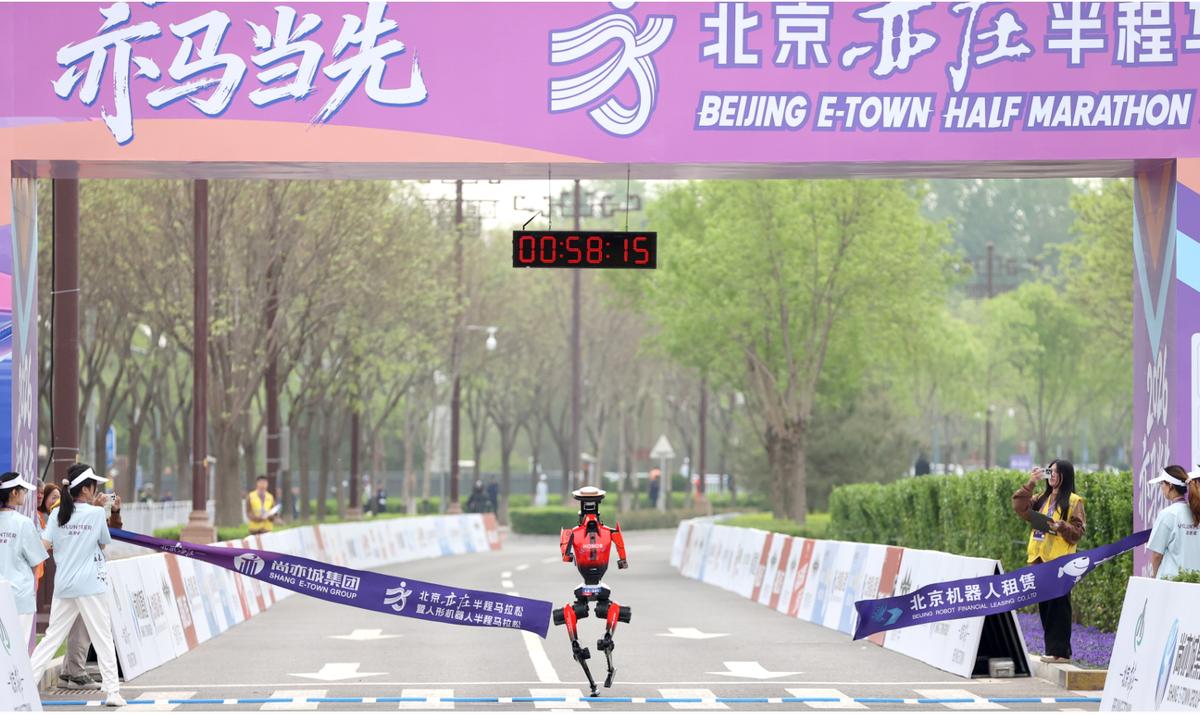
(Source: Beijing E-Town.)
There were two main groups of robots – those that were controlled remotely by humans, and “autonomous” robots. Autonomous robots use their own Artificial Intelligence (AI) systems to guide themselves along the course. These robots had to be aware of the road ahead and the activity around them.
Not all the robots ran well. Some fell. Others ran off the course. Many had to stop because of problems. Even the winning robot fell down at one point. But it was able to get back up and finish the race. In all, 47 robots finished.
😕
This image has not been loaded because of your cookie choices. To view the content, you can accept 'Non-necessary' cookies.
There were two main groups of robots – those that were controlled remotely by humans, and “autonomous” robots. Autonomous robots use their own AI systems to guide themselves along the course. In all, 47 robots finished the race. Above, two robots cross the finish line.
There were actually several Lightning robots in the race. One of them was remote-controlled and set the fastest time of all, finishing in just 48 minutes, 19 seconds. But because of the way the race was scored, an autonomous Lightning robot was judged the winner.
Lightning has long legs and a liquid cooling system, which helps keep it from overheating. It also has a system that helps it keep its balance. Lightning robots came in first, second, and third in the race.
😕
This image has not been loaded because of your cookie choices. To view the content, you can accept 'Non-necessary' cookies.
Autonomous Lightning robots came in first, second, and third in the race (above), though another remote-controlled Lightning actually finished faster. Lightning was created by Honor, a Chinese company best known for its phones. Honor did not even begin working on robots until last year.
Lightning was created by Honor, a Chinese company best known for its phones. It may be surprising, but Honor did not even begin working on robots until last year.
The race was meant as a showcase for China’s efforts in robotics. That’s an area that many people think will be extremely important in the future. China already has more robots doing actual work than all other countries combined.
Given the huge improvements that happened in just one year, it’s hard to predict what robots might be able to do in the future.
Did You Know…?
Japan Airlines is now running tests at Tokyo’s Haneda Airport to see how well humanoid robots can help with jobs around airplanes. The airline is testing how the robots do with loading and unloading bags, and with cleaning jobs inside its airplanes.
😕
This map has not been loaded because of your cookie choices. To view the content, you can accept 'Non-necessary' cookies.