
San Antonio, Texas —(Map)
Scientists have reported on an unusual “hybrid” bird spotted in Texas – a cross between a blue jay and a green jay. The discovery is surprising because the two species are quite different. Scientists think the hybrid could be a result of climate change.
Brian Stokes is studying for his Ph.D. at the University of Texas at Austin. His work focuses on green jays – tropical birds common in Central America and Mexico.
As part of his work, Mr. Stokes keeps his eye out for postings about birds on social media. This helps him keep track of where green jays are turning up.
In 2023, Mr. Stokes saw a photo of an unusual-looking bird on social media. It was blue and looked similar to a blue jay, a bird common in Eastern North America. But something wasn’t quite right. The colors were different. And instead of having white face coloring like a blue jay, this bird had a black mask.
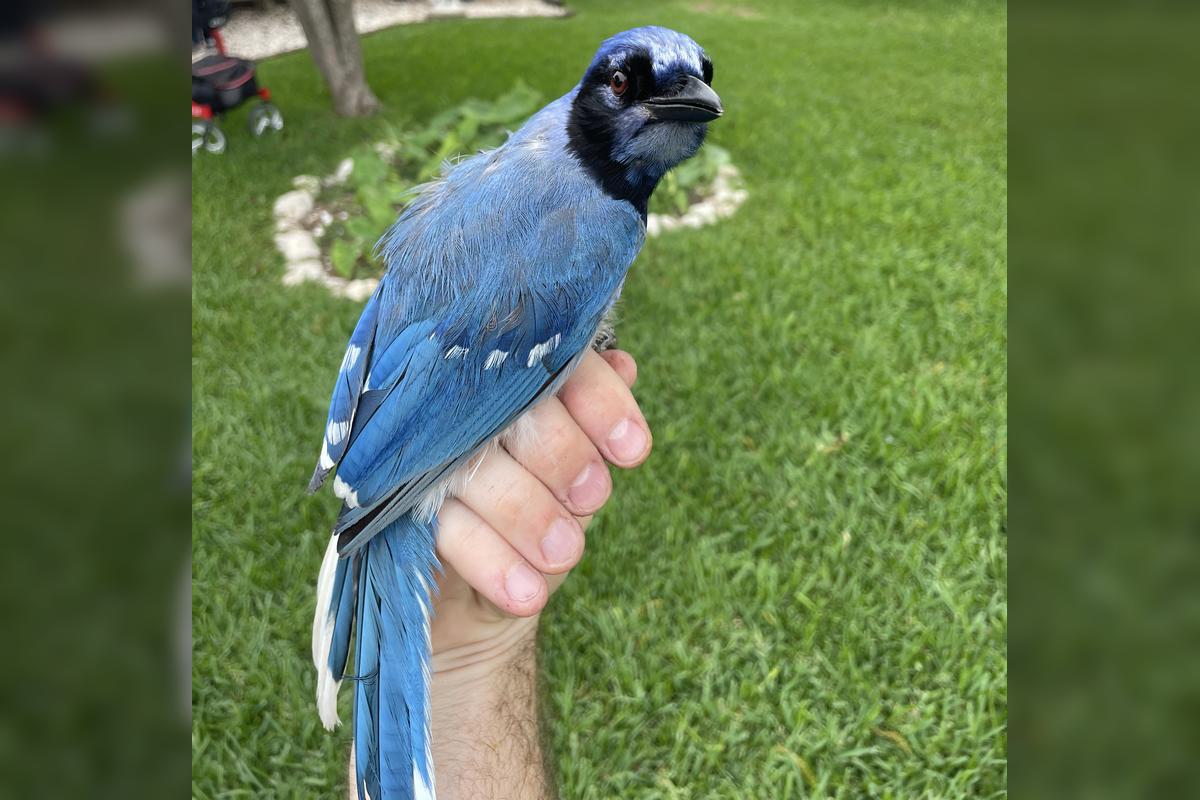
(Source: Brian Stokes/University of Texas at Austin.)
Mr. Stokes got in touch with the woman who had posted the picture, and she invited him to come see the bird for himself. To study the bird more carefully, Mr. Stokes brought a light net that he hoped would allow him to capture the bird temporarily.
It took a lot of effort, but on the second day, he was able to catch the bird. Quickly, he got a few pictures, took a blood sample, and then banded the bird’s leg so it could be identified later. Then he released it, unharmed.
Working with a biology professor at the university, Mr. Stokes confirmed that the bird was a hybrid. The father was a blue jay (common in Eastern North America) and the mother was a green jay (common in Central America).
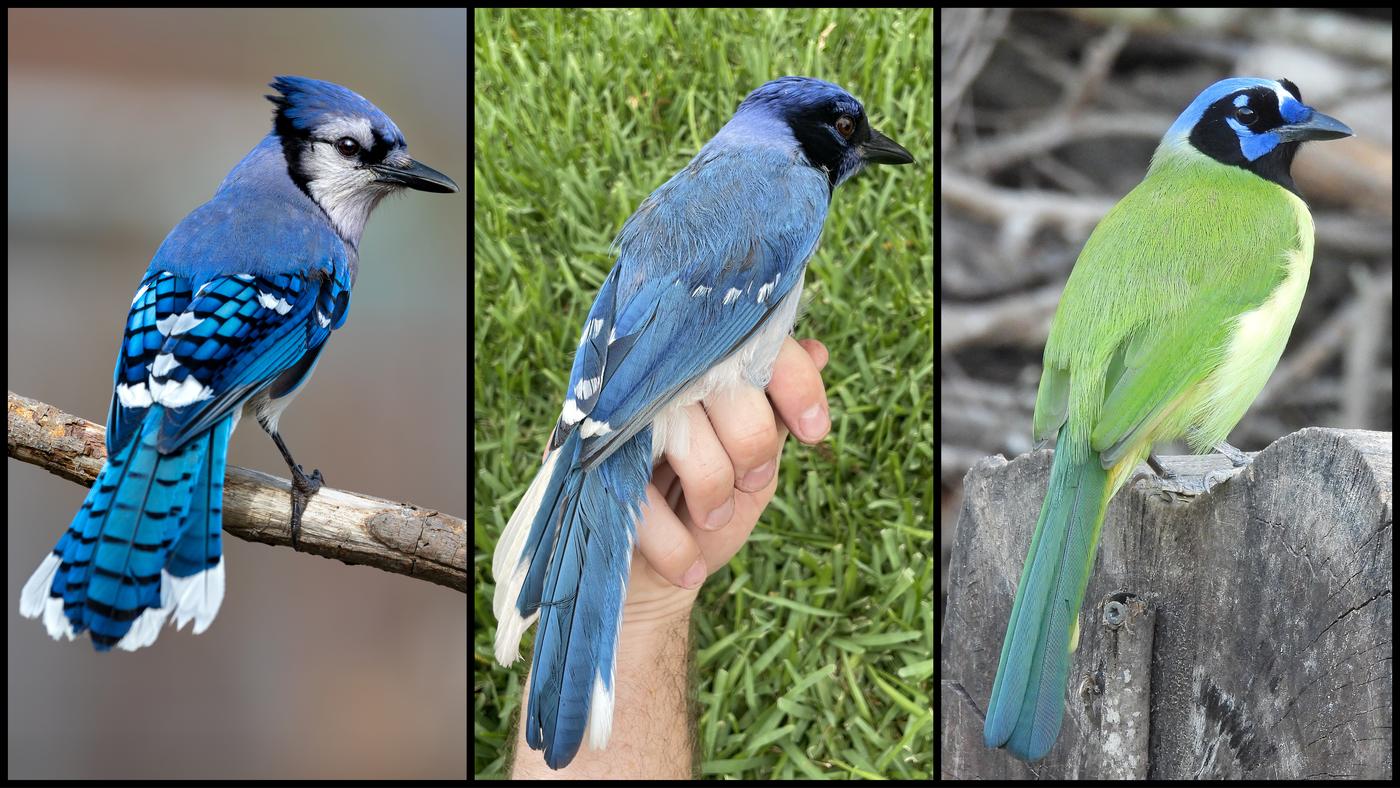
(Source: Center: Brian Stokes (University of Texas at Austin), Left: Travis Maher, Right: Dan O’Brien (both at Cornell Lab of Ornithology, Macaulay Library).)
Such a hybrid is very surprising. Long, long ago, both kinds of jays developed from the same kind of bird. But for seven million years, their species have been completely separate.
Animal hybrids aren’t unknown, but they are uncommon. In general, they happen when animals begin turning up in places where they don’t normally exist.
Sometimes this is the result of invasive species. Sometimes, it’s because the range of a species – the area in which it travels – changes.
For example, as the Arctic has warmed up because of climate change, polar bears have been traveling farther south in search of food. This has brought them in contact with grizzly bears, which has resulted in hybrids of the two species. These are sometimes called “grolar” or “pizzly” bears.
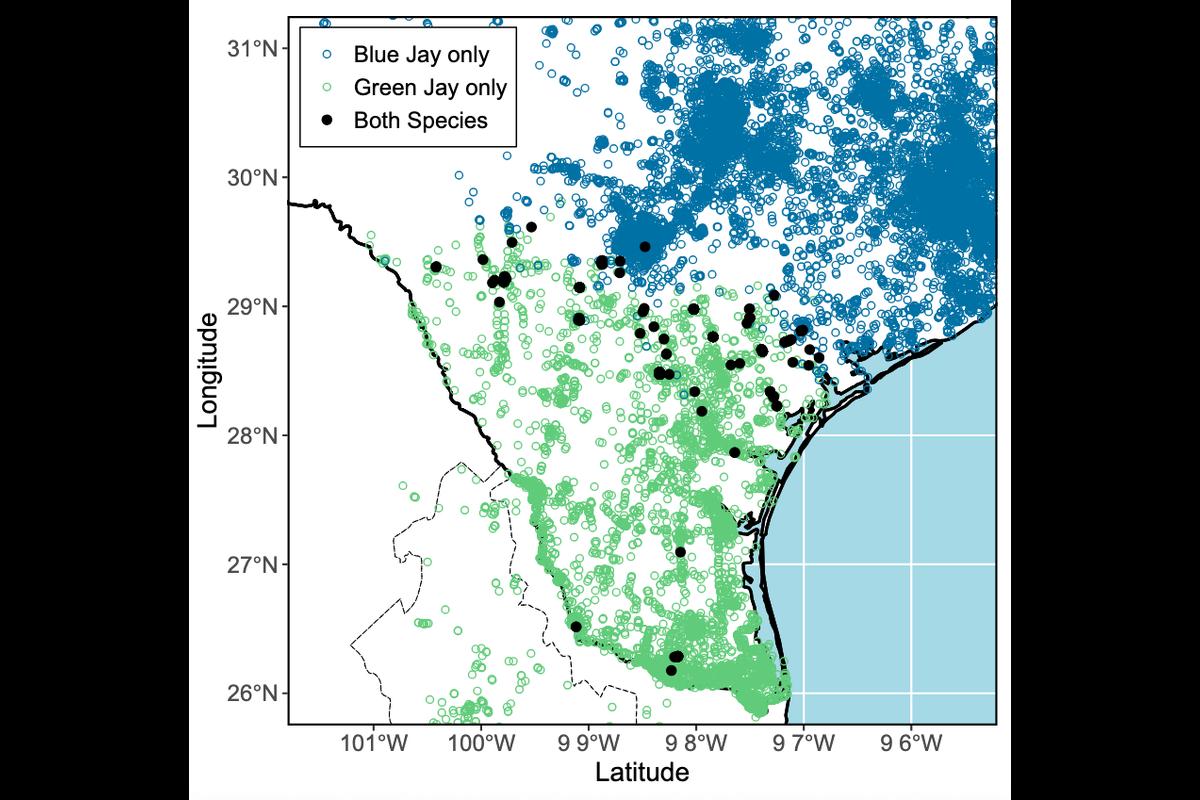
(Source: Brian Stokes/University of Texas at Austin.)
The researchers haven’t given the hybrid a name yet, but they wondered if it should be called a “Grue Jay”.
The scientists say the Grue Jay hybrid is also likely the result of climate change. In the mid-1900s, the range of the two birds did not really overlap. But in recent years, as the climate has warmed, green jays have been moving farther north, and blue jays have been traveling farther west.
The Grue Jay that Mr. Stokes studied in 2023 is doing just fine. It showed up again in the same back yard just this summer.
Did You Know…?
The scientists say that hybrids “are probably way more common in the natural world than researchers know,” simply because scientists can only study a small part of all that goes on.
😕
This map has not been loaded because of your cookie choices. To view the content, you can accept 'Non-necessary' cookies.