
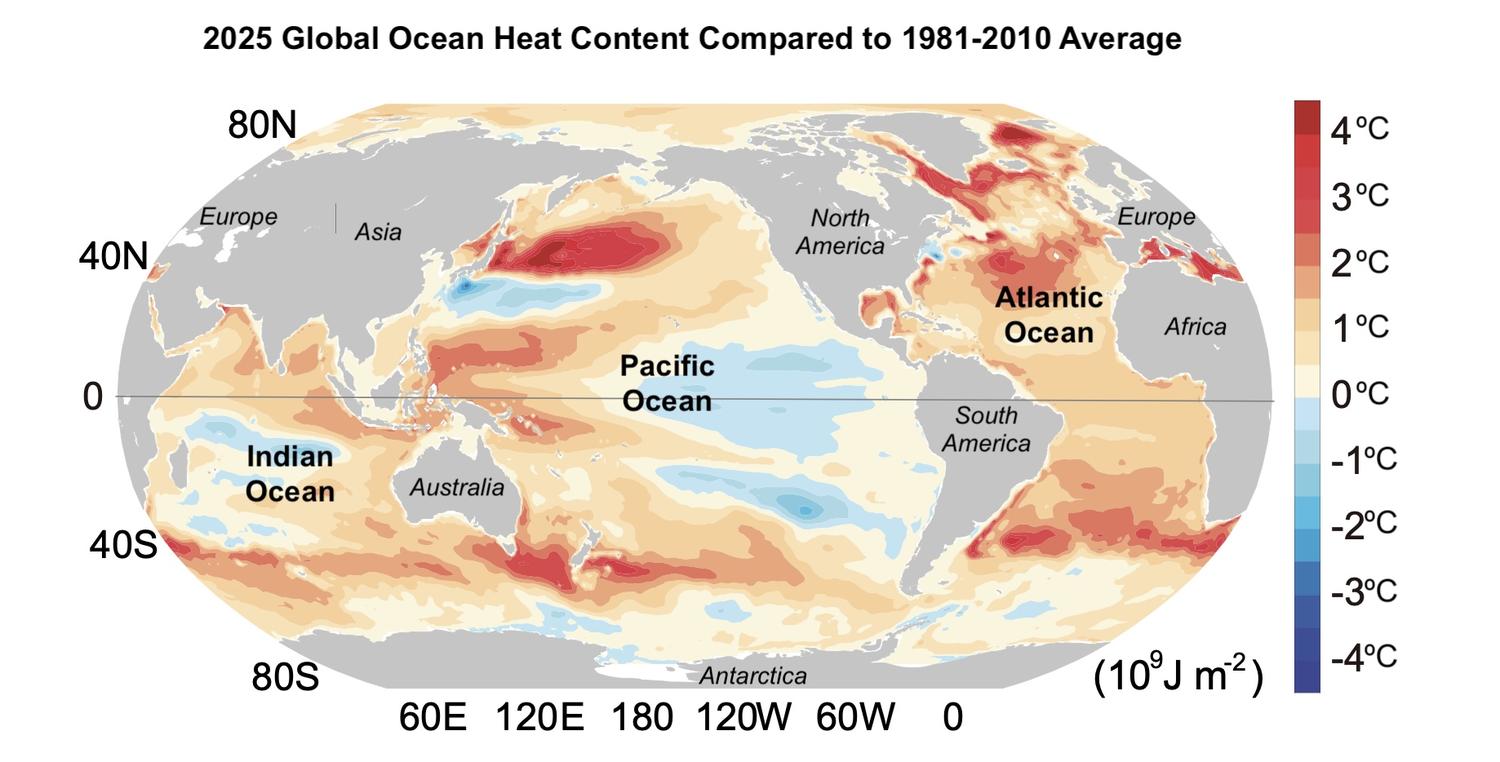
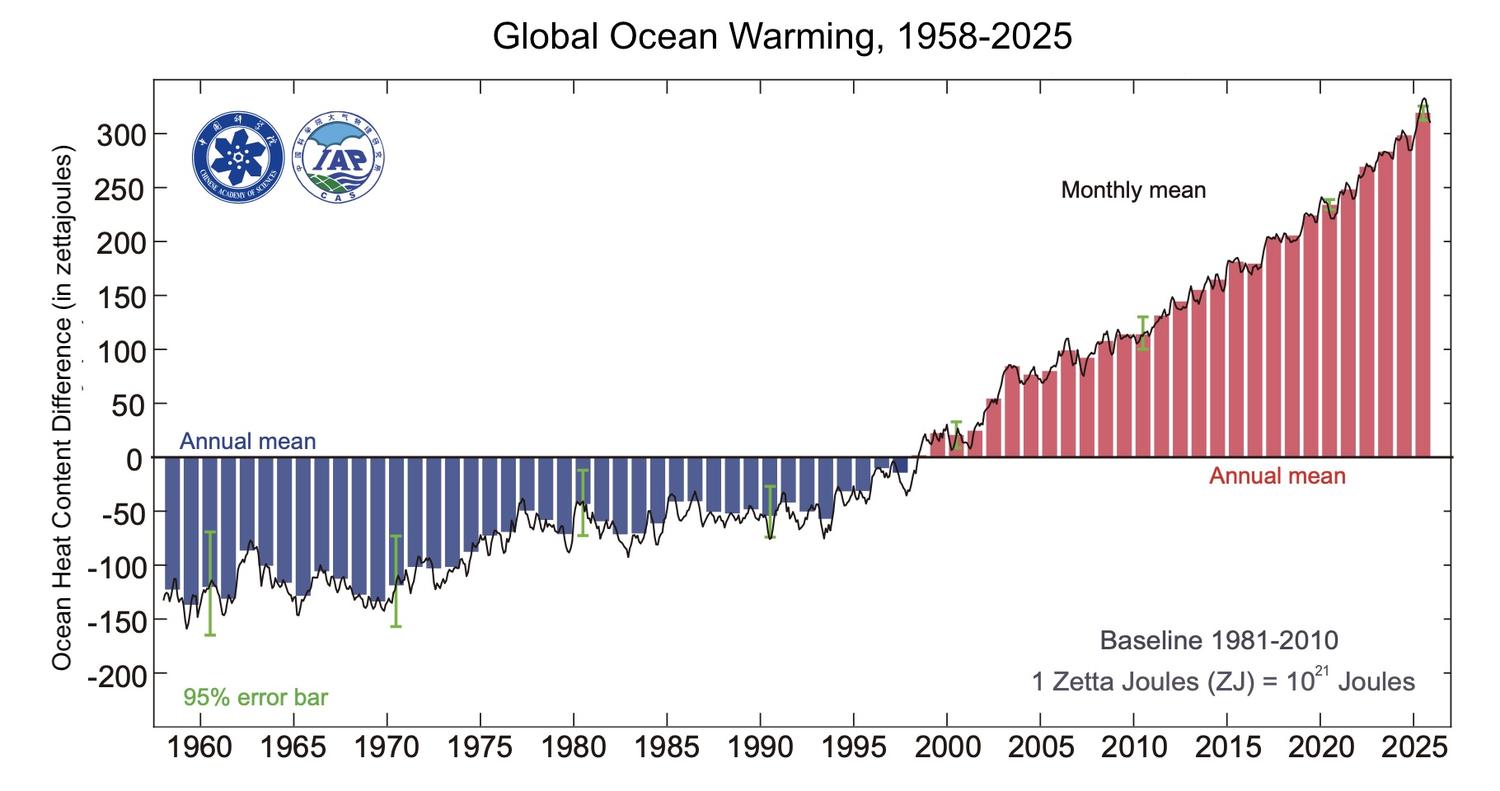
Scientists have released a new report showing that in 2025, the world’s oceans heated up more than ever. The oceans have set new records for heating eight years in a row. The scientists say this is a clear sign that the planet is warming because of human actions. The effects will last for hundreds of years.
The oceans are a key part of Earth’s climate system – they cover about 70% of the Earth. And oceans are the place where 90% of the extra heat energy on Earth gets stored. This makes measuring the amount of heat in the oceans one of the best ways to determine how the Earth is warming.
(Source: Pan et al. [CC BY 4.0], via Advances in Atmospheric Sciences .)
For most reports on global warming, scientists measure air temperatures over land and at the ocean’s surface. These measurements are important because ocean surface temperatures affect weather patterns, and life that depends on the ocean.
But surface temperatures don’t tell the whole story. Though the ocean surface is warming, heat is also going far deeper than that. The new report looks at “Ocean Heat Content” (OHC) – heat going down as deep as 1.25 miles (2 kilometers) below the surface.
The study, written by over 50 scientists from around the world, used lots of different information to calculate the ocean’s heating. This included data from research ships, satellites, and floating buoys. The team even put sensors on sea animals because they could go places robots normally can’t.
(Source: Pan et al. [CC BY 4.0], via Advances in Atmospheric Sciences .)
Climate scientist Kevin Trenberth says it takes about 25 years for the heat to reach this depth. And that heat will remain in the ocean for hundreds of years.
The amount of heat the oceans have taken in is so massive that it’s hard to understand. Energy is measured in “joules”. An AA battery, for example, stores about 10,000 joules of energy.
But the extra energy that is warming the deep ocean has to be measured in “zettajoules”. A zettajoule is 1,000,000,000,000,000,000,000 joules. In 2024, Earth’s oceans absorbed 16 zettajoules more than in 2023. And last year, the Earths oceans took in 23 zettajoules more than in 2024.

(Source: Asim18 [CC BY 3.0], via Wikimedia Commons.)
That’s an incredibly huge amount of energy. Scientist John Abraham, who helped write the report, has another way to think about the extra energy that the oceans absorbed: It’s as if 12 atomic bombs exploded in the oceans last year – enough energy to boil the water of 2 billion Olympic-sized swimming pools.
The warming of the oceans is already having serious effects. It is linked to stronger storms, more wildfires, and deadly floods. Higher ocean temperatures are also causing “marine heatwaves”, which have led to the melting of huge amounts of ice in Greenland and Antarctica.
Rising ocean temperatures are also threatening coral reefs, which provide support to over 25% of life in the ocean.

(Source: Wikipedia.org.)
The scientists say that the world will continue to see rising ocean temperatures until greenhouse gas emissions are cut to zero. Even then, it will take centuries for the oceans to cool back down. Still, the researchers believe there’s hope. Dr. Abraham says, “We can solve this problem today, with today’s technology.”