
Scientists at the University of Pennsylvania have developed some of the world’s smallest robots. The tiny, light-powered robots are smaller than a grain of salt. But they have a built-in computer and can control their own movements as they swim through water.
For decades, scientists have worked to make smaller and smaller robots. But as robots get small, they also become fragile and are easily broken. The new robots have been designed without any moving parts.
The devices are smaller than a grain of salt, and can barely be seen without a microscope. Marc Miskin, who led the work, says, “We’ve shown that you can put a brain, a sensor and a motor into something almost too small to see, and have it survive and work for months.”
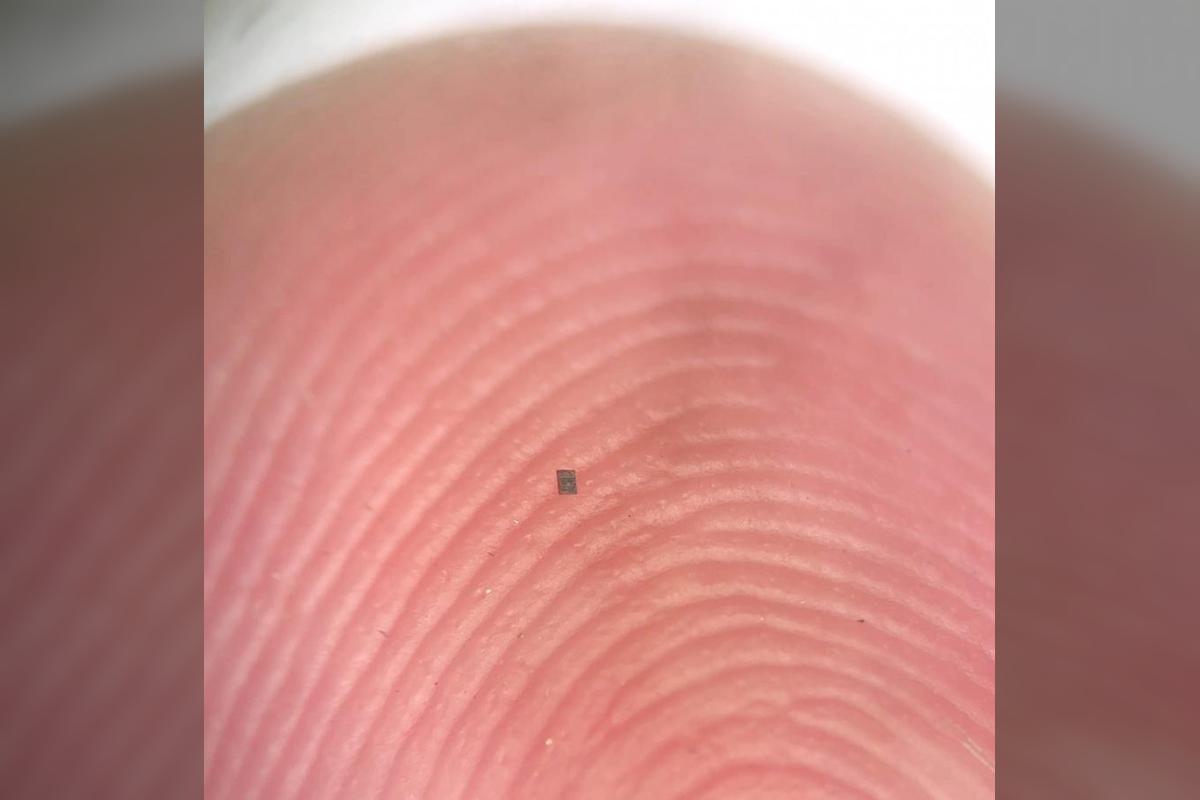
(Source: Marc Miskin, via University of Pennsylvania .)
The scientists faced many challenges in developing such tiny robots. To power the robot, the team chose to use a solar panel . This allows a robot to run for months, powered only by light. But it also meant that they had to cover much of the robot with the solar panel, which didn’t leave room for much else.
Scientists at the University of Michigan helped by developing a super tiny computer. Despite its size, this computer can be programmed and even has a memory. The researchers use flashing lights to program the robots. Once the robots are programmed, they can move on their own, with no outside control.
In spite of the advanced technology, the robots are cheap to produce. They cost about one US cent each.
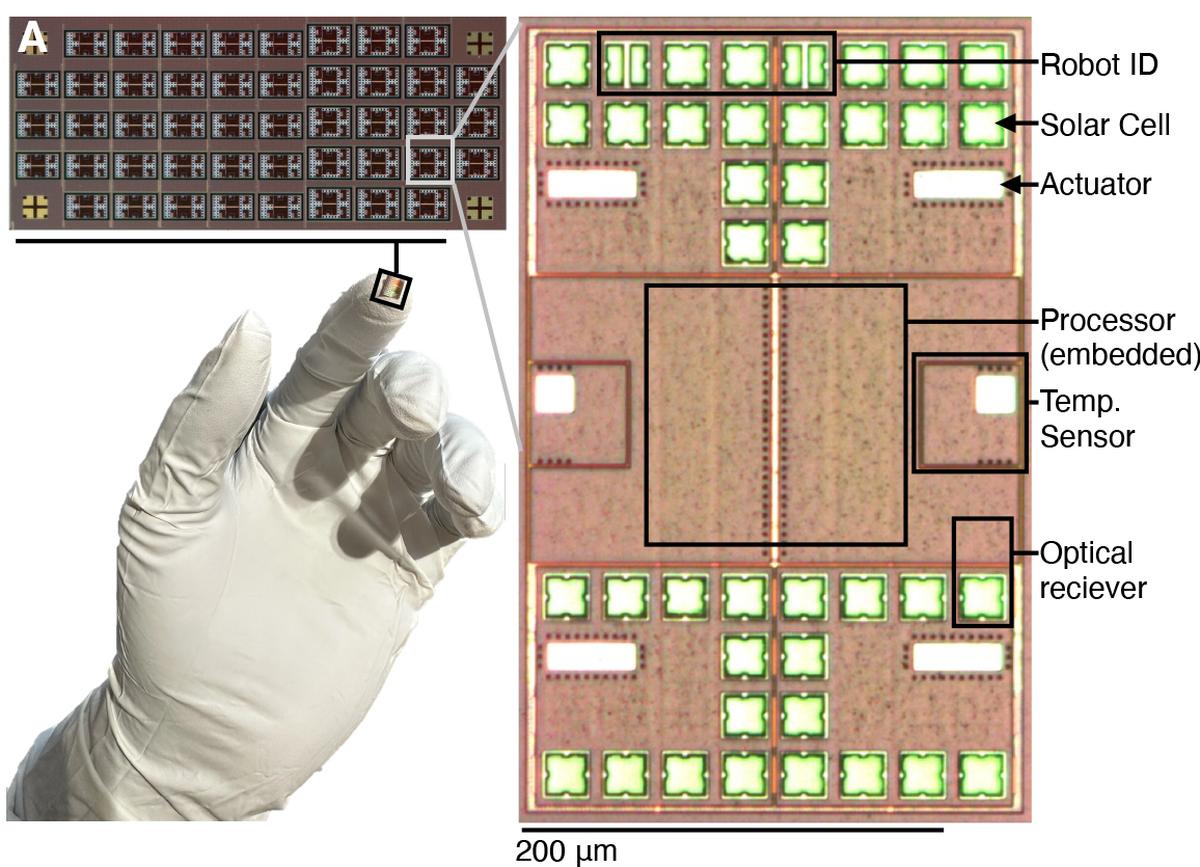
(Source: Miskin Lab and Blaauw Lab, via University of Pennsylvania .)
Getting the robots to swim was a challenge. Fish move forward by pushing the water behind them backward. But for a robot so tiny, moving through water is hard. Dr. Miskin says, “If you’re small enough, pushing on water is like pushing through tar.”
So instead, the robots create a tiny electric field around themselves. This field makes the charged atoms (called ions) in the surrounding liquid move. When those ions move, they bump into nearby water molecules and push on them. The moving water then carries the robot forward.
So what can the robots do? For one thing, they can sense the temperature of the liquid they’re in. They can also be programmed to swim toward warmer temperatures.

(Source: Lucas Hanson and William Reinhardt, University of Pennsylvania .)
The scientists had to get creative to think of a way for the robots to communicate. The robots share information through movement. For example, once a robot has measured the temperature, it can do a little dance.
Researchers watching through a microscope can then decode the dance to get the information. “It’s very similar to how honey bees communicate with each other,” says David Blaauw, who developed the robot’s computer.
The scientists say the project is really only the “first chapter”. They believe the robots offer lots of possibilities for the future. One possibility is that someday similar robots could be used to report on the health of cells in the human body. And, though each robot is tiny, they can be programmed to work together to tackle larger tasks as a group.