
For over 100 years, scientists have wondered how cats manage to land on their feet when they fall. Some questions about how cats do this have been solved. But many mysteries remain. Now, researchers in Japan have shown that part of the secret may have to do with the way a cat’s spine is built.
In 1894, a scientist named Étienne-Jules Marey took the first pictures of a cat turning in the air as it fell. The pictures showed that the cat was able to flip itself over in the air so that it landed on its feet. This was unusual. It seemed to go against the laws of physics. Scientists called this the “falling cat problem”.
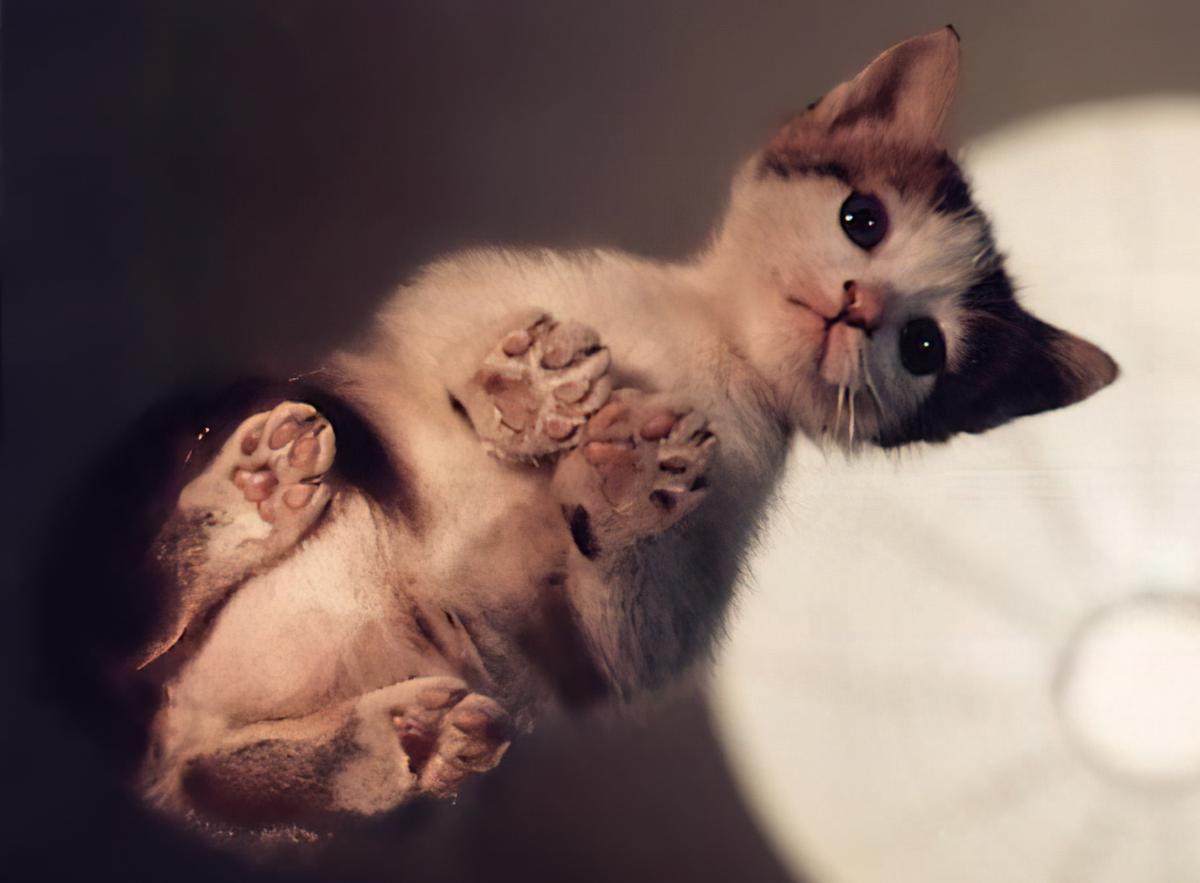
(Source: Nevit Dilmen [CC BY-SA 3.0], via Wikimedia Commons.)
Normally, for an object to begin spinning in midair, it must have a force pushing on it. It took scientists a long time to show that a cat could actually use its own body to turn over in the air – without breaking the laws of physics. But scientists are still trying to figure out exactly how cats manage this trick.
Now, researchers at Yamaguchi University in Japan say that a cat’s backbone may hold the key.
The team, led by Yasuo Higurashi, decided to carefully study the spines of five cats which had died. They looked at each cat’s spine as having two different parts: the front half (called the thoracic spine), and the back half (called the lumbar spine).
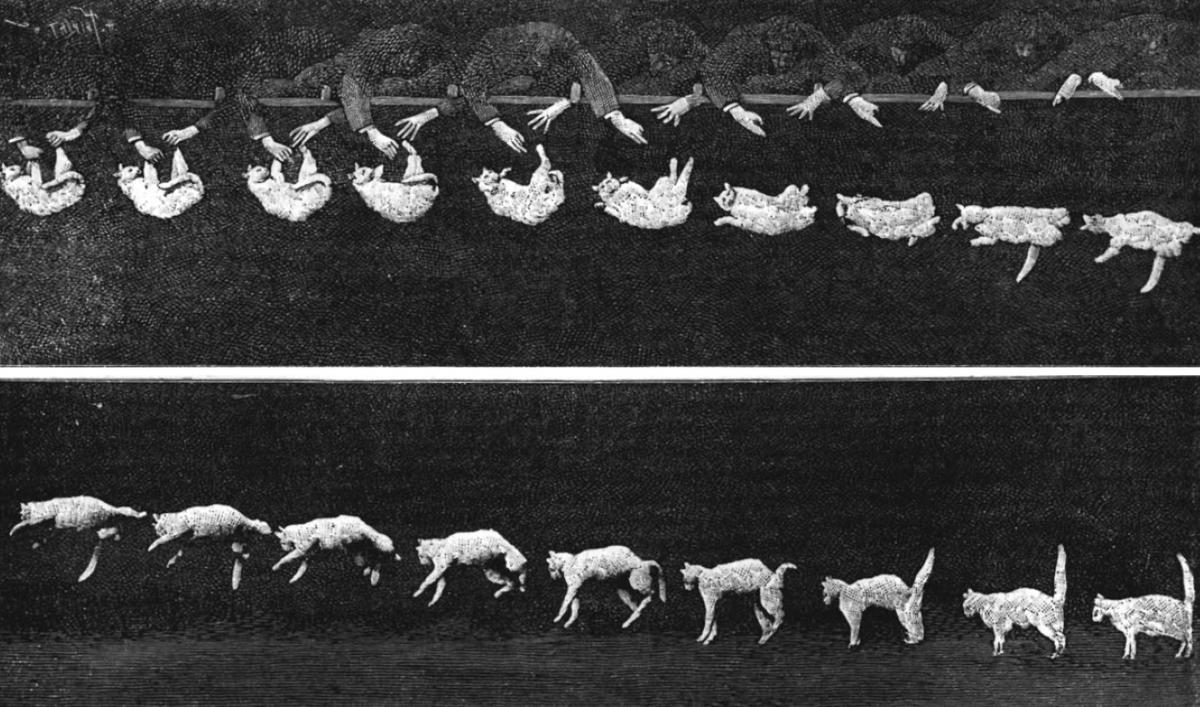
(Source: Etienne-Jules Marey [Public Domain], via Wikimedia Commons.)
They found that the front half of the spine was much more flexible than the back half. In fact, the front half could twist about three times as far as the back half. Dr. Higurashi says the front half of a cat’s spine can turn like a person’s neck. The rear part was much stiffer and heavier.
The researchers wanted to see if they could spot this difference in flexibility when cats were actually falling. So they studied two live cats. Using a high-speed camera, they recorded what happened as each cat was dropped onto a soft cushion from a height of about 1 meter (3.3 feet). Each cat was dropped eight times.
The videos revealed that the cats didn’t twist all at once. Instead, the front half of the cat’s body would twist first, followed by the back half.
😕
This image has not been loaded because of your cookie choices. To view the content, you can accept 'Non-necessary' cookies.
The researchers discovered that the front half of the cat’s body twists first because it is lighter, more flexible, and easier to move. Once the front half has turned, the stiffer and heavier back half can follow. The images above are not from the experiment.
The researchers say that the front half of the cat’s body twists first because it is lighter and more flexible, so it is easier to move. Once the front half has turned, the stiffer and heavier back half can follow.
The ability to move the front and back halves of the body in different ways may also help cats when they are running fast or turning quickly.
There are still plenty of mysteries about how cats can fall and land on their feet. But the new research gives scientists a better understanding of how a cat’s body helps it to twist.
In the future, the researchers hope to continue studying how cats move as they fall, and even create 3D models of these movements.
Did You Know…?
The experiment also turned up another unusual result: It seems that falling cats usually turn to the right. One of the cats always twisted to the right. The other one turned to the right 75% of the time.